Feed Processing Machines: 11 Essential Machines for Pet Food Production
The performance of a dry pet food does not depend on the extruder alone. Grinding affects particle consistency, mixing controls formula uniformity, drying influences shelf stability, and coating determines how evenly fats and palatants reach the kibble surface.
For manufacturers planning a new line or upgrading an existing factory, the real goal is not to buy the largest machine. It is to build a connected processing system that can repeatedly deliver the required kibble shape, moisture, density, nutritional quality, palatability, output, and production cost.
This guide explains the 11 essential feed processing machines in a typical dry pet food line, what each machine does, what buyers should compare, and where processing decisions can affect the final product.
What Are Feed Processing Machines?
Feed processing machines are the equipment used to convert raw materials into a consistent and stable finished feed. In a pet food factory, this normally includes equipment for:
- Raw-material receiving and cleaning
- Grinding and particle-size control
- Weighing and dosing
- Mixing
- Steam and moisture conditioning
- Extrusion or pelleting
- Cutting and shaping
- Drying and cooling
- Fat and palatant coating
- Screening and metal detection
- Weighing and packaging
These machines should not be evaluated as isolated units. A poorly controlled grinder can reduce mixer performance. Uneven conditioning can make extrusion unstable. Incorrect drying can change texture and coating absorption. An inaccurate coating system can make a good palatant appear inconsistent.
ANDRITZ’s official animal-feed equipment overview similarly organizes feed production around weighing, grinding, mixing, conditioning, pelleting, cooling, liquid addition, filtration, and automation systems.
Typical Pet Food Production Process
| Processing stage | Main equipment | Primary purpose |
|---|---|---|
| Raw-material preparation | Receiving system, cleaner, magnet, separator | Remove foreign material and protect downstream equipment |
| Size reduction | Hammer mill or other grinder | Create the required and consistent particle size |
| Formula preparation | Weighing, dosing, micro-dosing, mixer | Deliver the correct formula and uniform ingredient distribution |
| Pre-processing | Conditioner or preconditioner | Add heat, moisture, steam, and retention time |
| Product formation | Extruder or pellet mill | Cook, shape, expand, or compress the feed |
| Size control | Die and cutter | Produce the target diameter, shape, and length |
| Moisture control | Dryer and cooler | Stabilize moisture and temperature for storage |
| Surface application | Drum coater, liquid sprayer, powder applicator, or vacuum coater | Add fats, oils, palatants, and selected heat-sensitive ingredients |
| Final quality control | Screener and metal detector | Remove fines, oversize pieces, and metal contamination |
| Packing | Weigher, bagger, sealer, and coding system | Protect, identify, and prepare the finished food for distribution |
1. Raw-Material Receiving and Cleaning Equipment

The production line begins before grinding. Grains, protein meals, starches, fibers, mineral ingredients, and other dry materials may contain stones, metal fragments, oversized particles, packaging material, or other foreign matter.
Receiving hoppers, screens, rotary dressers, air separators, and magnets help remove unwanted material. This protects the hammer mill, mixer, extruder, and conveying system while reducing physical-contamination risks.
When comparing cleaning equipment, review:
- Raw-material types and bulk density
- Maximum expected throughput
- Screen opening and separation efficiency
- Magnet strength and access for cleaning
- Dust-control requirements
- Ease of inspection and sanitation
A cleaning system should be designed around the actual ingredients used by the plant, not only the nominal capacity of the line.
2. Hammer Mill or Grinding Machine
Grinding reduces raw materials to a controlled particle size before mixing and extrusion. A hammer mill uses rotating hammers and a screen to reduce particles, while other grinding technologies may be selected for specific ingredients or texture targets.
Particle-size consistency affects:
- Ingredient distribution in the mixer
- Water and steam absorption
- Extruder stability
- Kibble appearance and internal structure
- Die wear
- Energy consumption
- Finished-product texture
The ANDRITZ hammer-mill guide notes that the correct grinding setup supports later processes such as mixing, pelleting, and extrusion.
Important purchasing factors include screen size, rotor speed, motor power, hammer configuration, aspiration, temperature control, wear-part access, noise, vibration monitoring, and the range of particle sizes the machine can produce.
Do not evaluate a grinder only by tons per hour. A high output is not useful if particle variation creates problems at the extruder.
3. Weighing, Dosing, and Micro-Dosing Systems
The weighing system determines whether the production formula is reproduced accurately. Macro ingredients may be dosed through large bins and scales, while vitamins, minerals, preservatives, pigments, flavors, and other low-inclusion ingredients require smaller and more precise systems.
Buyers should compare:
- Accuracy at both high and low inclusion levels
- Number and size of ingredient bins
- Screw, loss-in-weight, or volumetric feeding options
- Prevention of bridging and segregation
- Batch traceability
- Cleaning and allergen-control procedures
- Integration with formula-management software
The smallest ingredients often have the largest effect on nutritional compliance and batch consistency. A feed line should therefore be designed around the required dosing tolerance, not merely the number of available bins.
4. Feed Mixer
After dosing, a paddle or ribbon mixer distributes dry and liquid ingredients throughout the batch. The target is not simply to move the material; it is to achieve a uniform mixture within a practical mixing time and then discharge it without excessive residue or segregation.
Mixer performance depends on:
- Usable batch volume
- Ingredient density and particle-size differences
- Paddle or ribbon design
- Filling level
- Mixing time
- Liquid-addition method
- Discharge speed and residual material
- Access for inspection and cleaning
Poor mixing may create bags with different nutrient levels, colors, aromas, or extrusion behavior. Before purchasing, ask the supplier to demonstrate mix uniformity using ingredients similar to the planned formula.
5. Conditioner or Preconditioner
A conditioner prepares the mixed meal before it enters a pellet mill or extruder. It introduces controlled amounts of steam, water, and sometimes other liquids while providing mixing and retention time.
According to the ANDRITZ conditioner overview, effective conditioning uses heat, moisture, and time to prepare material for pelleting or extrusion and can support more uniform feeding and liquid absorption.
For pet food production, conditioning can influence:
- Moisture distribution
- Starch cooking and binding behavior
- Extruder stability
- Energy use in the extruder
- Kibble expansion and density
- Production capacity
Key comparison points include retention time, steam quality, water-addition accuracy, paddle adjustment, temperature measurement, discharge consistency, hygienic design, and ease of cleaning.
6. Pet Food Extruder or Pellet Mill
The forming machine is the center of the line, but the correct choice depends on the product.
Extruder
Extruders are widely used for dry pet food because they combine mixing, thermal and mechanical energy, pressure, cooking, and shaping. As the product exits the die, the pressure change helps create the kibble’s internal structure. Die geometry and operating conditions influence shape, expansion, density, texture, and appearance.
ANDRITZ describes pet food extruders as flexible systems designed to produce different pet-food shapes, colors, flavors, and product characteristics.
When selecting an extruder, consider:
- Single-screw or twin-screw configuration
- Formula flexibility
- Target product density and expansion
- Die and cutter options
- Moisture and steam-control capability
- Specific mechanical energy monitoring
- Wear-part life and replacement cost
- Cleaning and changeover time
- Actual sustained output for the planned recipe
Pellet mill
Pellet mills compress conditioned meal through die openings. They are common in livestock feed and may also be suitable for selected pet, treat, or specialty-feed products that do not require the expanded structure of conventional dry kibble.
Do not choose between extrusion and pelleting based only on machine price. The product’s texture, density, digestibility target, shape, moisture, fat level, market positioning, and required formula flexibility should drive the decision.
7. Die and Cutting Machine
The die defines the basic product profile, while the cutter controls length and helps create a uniform appearance. Cutter speed, blade number, blade condition, product flow, and die geometry all affect the final dimensions.
Inconsistent cutting may cause:
- Excessive fines
- Uneven drying
- Poor package appearance
- Different texture between pieces
- Difficult coating and screening
Manufacturers producing several pet sizes or product shapes should compare the time required for die changes, cutter adjustment, cleaning, and production restart.
8. Feed Dryer
Fresh extrudate normally contains more moisture than the finished product can safely retain. A dryer uses controlled airflow, temperature, bed depth, and residence time to bring the product toward the target moisture.
Drying must be uniform. Under-dried pieces can create stability risks, while excessive drying can increase energy use, reduce yield, alter texture, and change how the kibble accepts surface coatings.
Important dryer specifications include:
- Airflow uniformity
- Number of drying zones
- Temperature and humidity control
- Bed-depth control
- Residence-time range
- Product turnover or conveying design
- Heat recovery and energy efficiency
- Cleaning access
The correct dryer should be sized for the actual product moisture load, not only the extruder’s nominal output.
9. Cooler
Cooling reduces product temperature after drying or pelleting and prepares the feed for coating, screening, storage, or packaging. Packaging hot product can create condensation and accelerate quality loss.
The cooler should deliver a controlled and consistent discharge temperature without damaging the product. Consider airflow, residence time, product depth, ambient conditions, dust collection, discharge uniformity, and seasonal changes in factory temperature and humidity.
Cooling strategy must also match the coating process. Some liquid coatings spread differently on warm and fully cooled kibble, so the equipment supplier, formulation team, and palatant supplier should agree on the target application temperature.
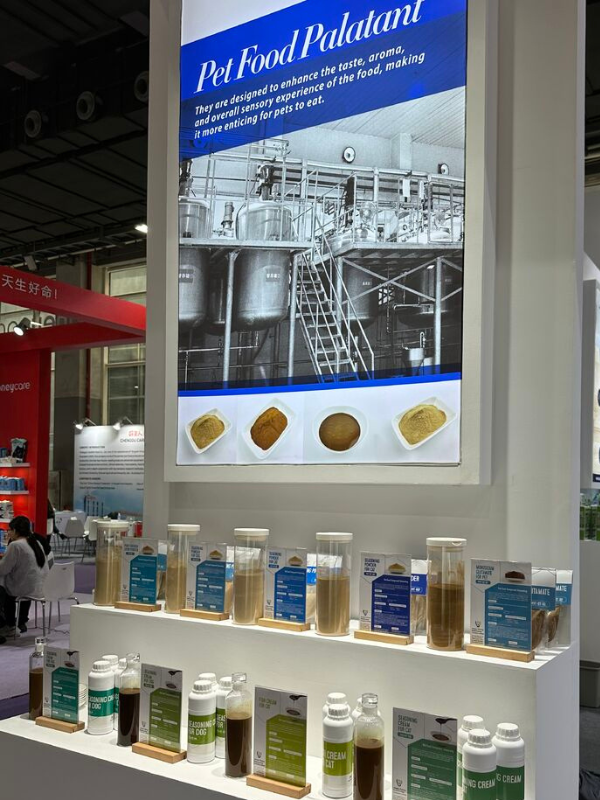
10. Feed Coating Machine and Palatant Application System
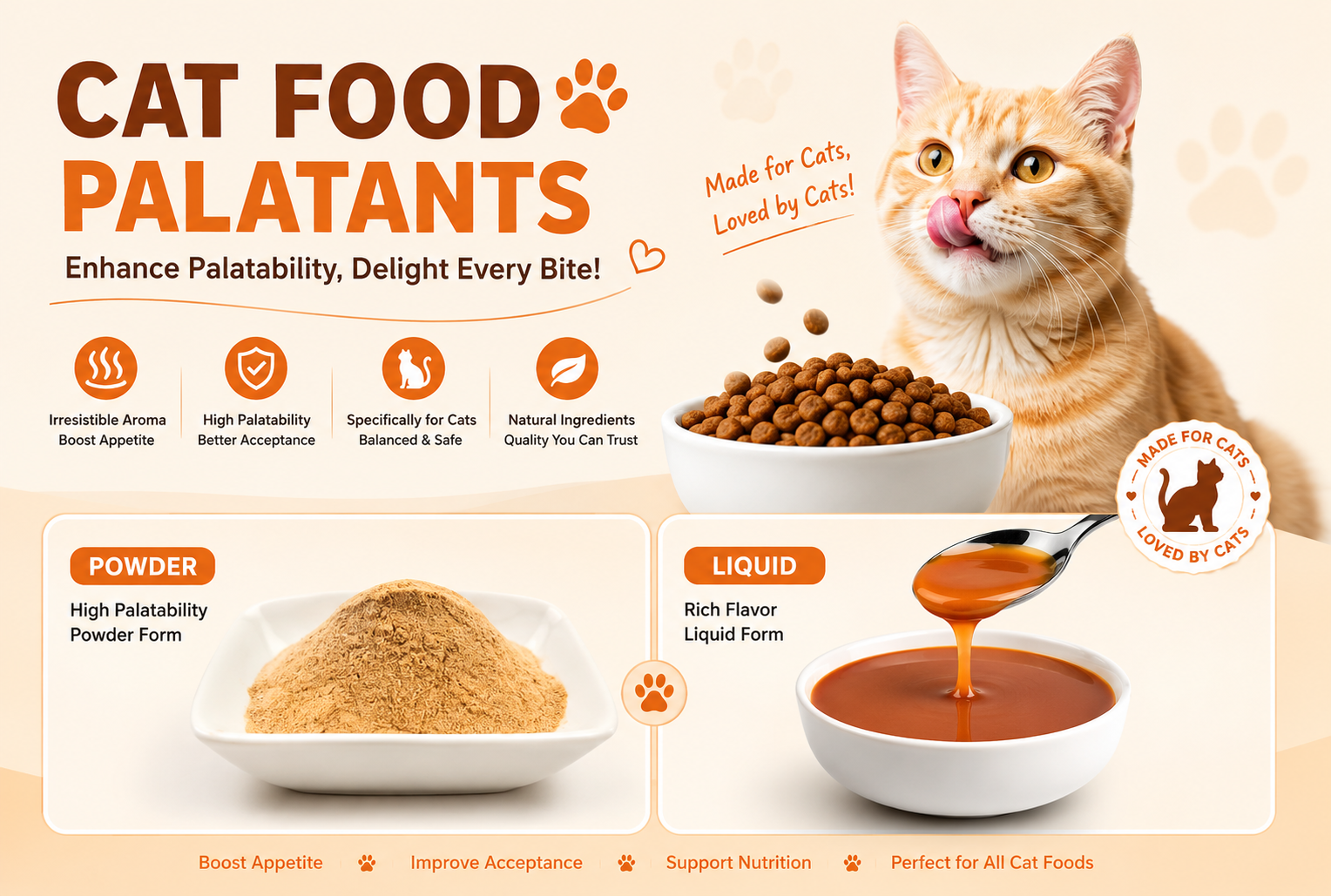
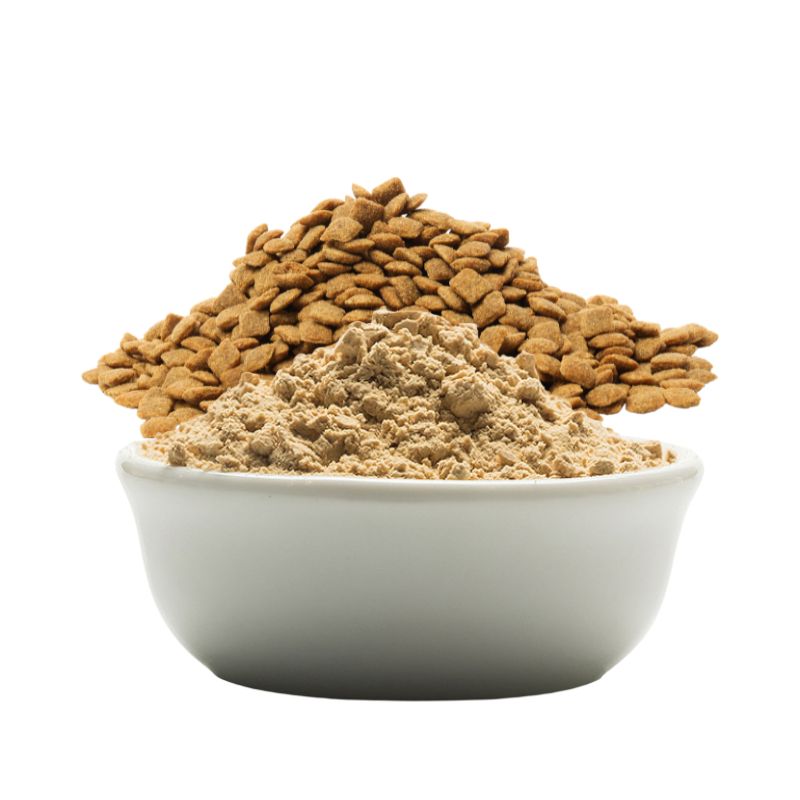
The coating stage is especially important for pet food because fats, oils, liquid palatants, powder palatants, and selected heat-sensitive ingredients are often added after extrusion and drying.
Common systems include:
- Liquid spray systems
- Rotating drum coaters
- Paddle or vertical coaters
- Powder applicators
- Vacuum coaters
A conventional surface-coating process may apply fat first, followed by liquid palatant and then powder palatant. The best sequence depends on the formula, product temperature, equipment, carrier system, target adhesion, and desired aroma release.
A vacuum coater uses a pressure difference to draw liquids into the porous structure of extruded feed. The ANDRITZ vacuum-coating explanation emphasizes control of vacuum pressure, liquid addition, cycle time, penetration, and repeatability.
When comparing feed coating machines, evaluate:
- Liquid and powder dosing accuracy
- Number of additives supported
- Spray-nozzle coverage and droplet size
- Mixing gentleness
- Coating uniformity
- Powder adhesion and dust loss
- Temperature control
- Cleaning between formulas
- Product breakage
- Ability to record actual application levels
For palatability, uniform application is usually more important than creating the strongest possible aroma. If part of the batch receives too little liquid or powder, feeding-test results and customer experience may vary even when the palatant itself is unchanged.
11. Screening, Metal Detection, and Packaging Machines
After coating, a screener removes fines, clusters, and oversize pieces. Metal detection provides another control point before packaging. The finished food is then weighed, filled, sealed, coded, and checked.
The packaging system must match bag size, material, line speed, oxygen and moisture-barrier needs, coding requirements, and checkweigher tolerance. Poor sealing or unsuitable barrier material can allow oxidation and aroma loss, reducing palatability during storage even when the product performed well immediately after production.
Important equipment may include:
- Vibrating or rotary screener
- Metal detector or X-ray system
- Multihead or linear weigher
- Form-fill-seal or premade-bag machine
- Heat sealer
- Checkweigher
- Date and batch coder
- Case packing and palletizing system
Why Automation Matters Across the Entire Line
Automation is not a separate replacement for good machines. It is the control layer that connects formulas, dosing, temperature, moisture, energy, alarms, traceability, and production records.
An effective system can help the factory:
- Recall and protect approved recipes
- Control dry and liquid dosing
- Monitor moisture and temperature
- Record batch and raw-material data
- Reduce operator-dependent variation
- Manage startup and shutdown losses
- Change formulas more quickly
- Identify abnormal conditions before product quality is affected
ANDRITZ’s pet-food automation guidance highlights exact dosing of dry and wet additives, moisture control, specific mechanical energy control, traceability, formula changes, and reduced startup or shutdown waste.
How Feed Processing Machines Affect Palatability
| Processing issue | Possible palatability effect | Machine or control point to inspect |
|---|---|---|
| Inconsistent particle size | Uneven extrusion and texture | Hammer mill, screen, feeder, aspiration |
| Inaccurate dosing | Formula and flavor variation | Scales, micro-dosing system, calibration |
| Poor mix uniformity | Uneven taste and nutrient distribution | Mixer loading, mixing time, liquid spray |
| Unstable conditioning | Variable expansion, density, and texture | Steam, water, retention time, feed rate |
| Excessive thermal treatment | Loss of attractive aroma or altered taste | Conditioner, extruder, dryer |
| Uneven drying | Different hardness and coating absorption | Airflow, bed depth, residence time |
| Poor coating coverage | Batch-to-batch preference variation | Pump, nozzle, coater, powder applicator |
| Packaging leaks | Oxidation and aroma loss during storage | Sealer, package barrier, leak testing |
This is why palatability troubleshooting should include production data. Increasing palatant dosage may not solve a mechanical problem such as a blocked nozzle, inaccurate pump, uneven drying, or excessive powder loss.
How to Choose Feed Processing Machines: A 7-Step Buying Process
Step 1: Define the finished product
Specify species, life stage, kibble dimensions, density, moisture, fat level, texture, shape range, packaging size, and expected shelf life.
Step 2: Confirm realistic production capacity
Ask for sustained output using formulas similar to yours. Nameplate capacity may not reflect high-meat, high-fiber, low-starch, high-fat, or specialty recipes.
Step 3: Map the full process
Identify every transfer point, storage bin, dosing stage, buffer, quality-control point, and cleaning requirement. A fast extruder cannot compensate for a grinder, dryer, or packer that limits the line.
Step 4: Define quality tolerances
Set acceptable ranges for particle size, mixing uniformity, product density, moisture, dimensions, fines, coating level, weight, and seal integrity.
Step 5: Evaluate hygienic design and changeovers
Review food-contact materials, weld quality, drainage, dust accumulation, dead zones, access, allergen control, wet or dry cleaning methods, and the time needed to change formulas.
Step 6: Compare total operating cost
Include energy, steam, compressed air, wear parts, screens, dies, blades, lubricants, labor, maintenance, cleaning time, downtime, and local service—not only the purchase price.
Step 7: Run trials before final approval
Use representative ingredients and target formulas. Measure output and energy use, but also inspect kibble structure, density, moisture uniformity, durability, coating performance, palatability, and aged-product stability.
Questions to Ask a Feed Processing Machine Supplier
- What sustained throughput can the machine achieve with our target formula?
- Which utilities and factory conditions are required?
- What are the normal wear parts and annual replacement costs?
- How long do cleaning and formula changeovers take?
- Can the controls exchange data with our existing plant system?
- Which process parameters are recorded for traceability?
- Can the supplier conduct pilot trials with our ingredients?
- What installation, commissioning, training, and local service are included?
- How is dosing or coating accuracy verified?
- What happens to output and quality when the formula changes?
- Which spare parts should be stocked on site?

Frequently Asked Questions
What is the most important machine in a pet food production line?
The extruder is central to dry kibble production, but the line performs only as well as its weakest stage. Grinding, dosing, conditioning, drying, coating, and packaging can all determine whether the final product meets its quality target.
What is the difference between a feed pellet mill and a pet food extruder?
A pellet mill compresses conditioned meal through a die. An extruder combines mixing, thermal and mechanical energy, pressure, cooking, and shaping, making it better suited to expanded dry kibble and products requiring greater control of texture, density, and shape.
Can one coating machine apply both liquid and powder palatants?
Some systems can handle both, while others require separate liquid spraying and powder application equipment. Confirm dosing accuracy, application sequence, adhesion, dust control, cleaning, and product breakage through trials.
Should palatants be added before or after extrusion?
Many pet food palatants are surface-applied after major heat processing to protect aroma and improve direct sensory contact. However, the best application stage depends on the palatant, carrier, formula, process temperature, and product format.
How can a factory improve coating consistency?
Calibrate pumps and scales, inspect nozzles, control product temperature and feed rate, verify mixing time, measure powder loss, sample different points in the batch, and connect actual addition data to the batch record.
Build the Production Line Around the Finished Product
Choosing feed processing machines is not a checklist exercise. Every machine changes the conditions faced by the next one, and each stage can affect product texture, moisture, stability, appearance, cost, and palatability.
For pet food manufacturers, the coating system deserves particular attention. A well-selected palatant cannot deliver consistent results if liquid dosing, powder distribution, kibble temperature, or coating coverage varies from batch to batch.
If you are upgrading a feed coating machine, developing a new kibble formula, or troubleshooting inconsistent intake, Profypet can recommend powder and liquid palatant samples and help plan application trials around your production process.
CTA: Request Pet Food Palatant Samples and Application Guidance